
Why Digital Twins are always a Win-Win
Introduction.
Across manufacturing, whether Mechanical, Automotive, Aerospace, Shipbuilding, Medical Products, Chemical or Processing Plants & Infrastructure, the 3D Model turns out as the main data source of Product information. Information from the 3D Model is utilized and shared within the organization, between various departments, and also with external players not limited to Customers, Certification Authorities, Organizations undertaking special studies or analyses (FEA, CFD, Wind Tunnel, etc), and Equipment OEMs or Component Suppliers.

Significant resources are likely to be engaged in data creation and exchange, and seen in the context of organizational efficiency, it is best to keep this to a minimum. This will need a deeper understanding of the “what” and “how” data is exchanged. Unstructured data may exist in excel spreadsheets, word docs, ppts, images, CAD neutral files such as dwg, dxf, step, stp, etc., and core structured data in the 3D Model, PLM, ERP or other Enterprise Servers. In this “Maze” of data, which can very easily tend towards becoming unmanageable or untraceable, the real challenge is to integrate data from different and disparate software platforms or applications and files.
Digital Twin — From the Digital Thread
Many organizations have moved to create a “Digital Thread” or backbone, which, in a manufacturing context, is the “single source of truth.” A very detailed description of a typical Digital Thread undertaken by EUROSTEP for BAE Systems was made during PI PLMx 2019 (A Flagship Data Integration Project in Support of the Royal Navy’s New Carriers). The “Digital Thread” in effect is the outcome of interconnecting several different software systems and applications, which can also turn out as a source for various content generated, as seen in Figure 1.
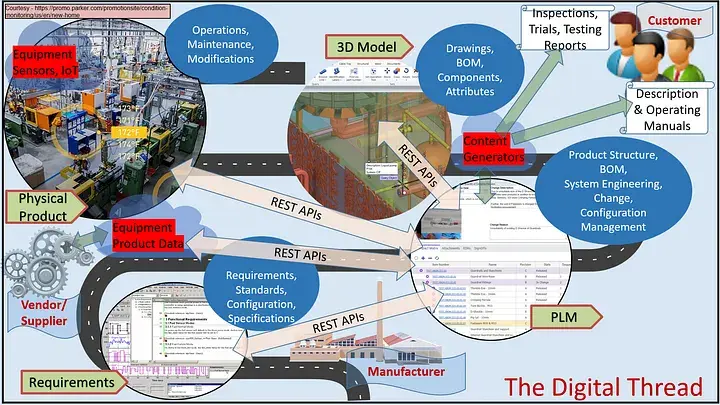
The Digital Thread implies connectivity between a Physical Product, its Digital Model, and Virtual Data Sources, hence, can be considered as a starting point for the “Digital Twin”. It is obvious that information and data associated with a Product are much more than just its 3D Model. Customers across Industries now expect the entire digital thread of their Product to be available for them, suitably integrated with the Physical Product(s). Customers or Asset Owners envisage this Digital Twin to be utilized during the operational lifecycle, for maintenance, repairs, and modifications until end of life of the Product.
In order to sustain the flow of large volumes of information through the product life cycle for the Digital Twin, it is prudent to find ways to “generate” them in a process-driven approach rather than create them manually during each instance. Here, “Content Generators” which are codes or methods to create documents, manuals, etc, from structured databases, can come into play. Such a feature is provided, for instance, in Aras which can be suitably customized for any data accessed through the PLM application (Using Content Generators in Tech Docs — English Blog — Aras Open PLM Community).
APIs for Integration
Web applications are the most popular means of accessing external or remote Server database applications through the Internet. While mobile web applications are dominant, there are also many custom web applications that are created for interactions and transactions within an organization (on-premise) or deployed in the Cloud. The back end of all these web application interactions is the APIs or Application Programming Interfaces.
It can be seen from Figure 1 that “REST APIs” are utilized for enabling data exchanges between different software such as Requirements Management to CAD & PDM. REST, an acronym for “Representational State Transfer”, is an interface that two computer systems can use to exchange data securely through internal networks or through the Internet. It follows a client-server pattern, in that, all information should be made by the server in its “response” to the “request” made by the Client and so on. Specific types of HTTP Requests are configured for getting, creating, updating, and deleting information on the server depending on the Request made. API “Endpoints” are coded within the data source applications to filter out from the Database which information to provide when a specific REST API Request call is received from external applications. Thus, any two disparate applications can be made to exchange information with each other by suitably wrapping the required information through REST API Endpoints. Two of the most beneficial aspects of using REST APIs are that, first, you can request for and obtain only the desired information, avoiding the need for obtaining the whole source and then searching for the desired data. API calls are also best suited for low bandwidth situations, within factory premises or remote locations. Moreover, the data is “live”, in other words, current or latest data is transferred. Hence, data latency, which can otherwise lead to manufacturing errors or performance issues later depending on the frequency of data changes is avoided.
An Integration of 3D Model & PLM
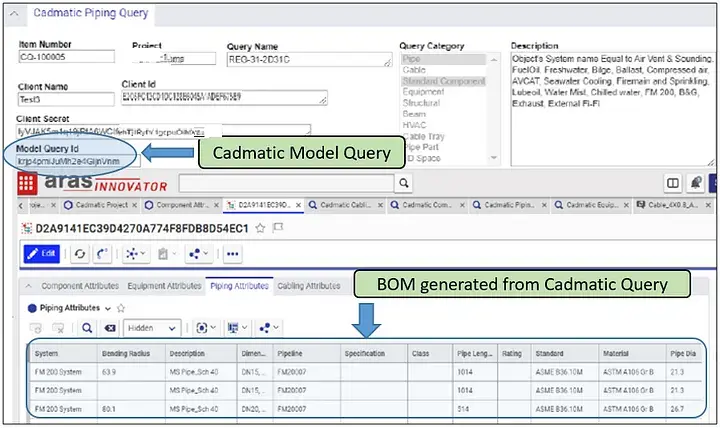
For a deeper insight on data exchanges, we can see how REST APIs create a two-way integration between CADMATIC’s Shipbuilding & Design 3D Modelling Software with Aras PLM. REST API functionality was introduced in Aras PLM from the Version11 sp12 version in 2018 (Tech Tip: Using the Aras RESTful API — English Blog). CADMATIC provided Web API “Endpoints”, released in mid-2020 (CADMATIC Web API). Coding is done from within Aras using these Web API Request endpoints, which facilitate the exchange of information with CADMATIC with REST calls. System-level or query-based BOMs from the CADMATIC Model is available through “GET” Requests in Aras, facilitating their management in PLM, which is more suited for BOM Management. Model “Queries”, such as for BOM Generation created in CADMATIC are executed from Aras and retrieved through “GET” Requests as seen in Figure 2.
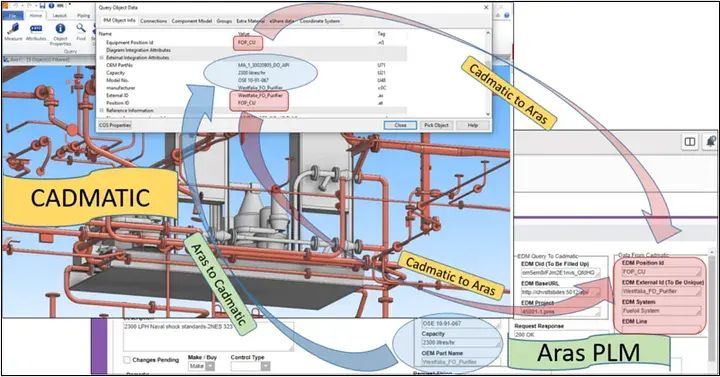
Similarly, “EDMs” or External Data Management objects for Equipment created in CADMATIC are linked by a unique External Id with Aras PLM, facilitating real-time data exchange of OEM Equipment information or other desired attributes. As seen in Figure 3, through “POST” Requests, this data is therefore readily available in the Drawings extracted from CADMATIC, avoiding any data mismatch. Aras has capabilities of executing the codes, stored as “Methods”, which can be set to execute “OnGet” or “OnUpdate” etc, of Items, thereby, synchronizing the REST API calls within the normal Item Type operations such as Get, Save, Update or Delete, etc.
Broadening the Digital Twin
A large number of Software providers are shipping their desktop or server applications with REST API capabilities enabling their connectivity to the Digital Thread. Hence, depending on the type of information to be transacted through the APIs, suitable endpoints can be created at the Software end. Solutions for integration of Requirements Management software such as IBM DOORS with various PLM Systems are already available. So is the case with Model Based System Engineering (MBSE) Tools and ERP Platforms. Digital Transformation is a success when the entire scope of Product or Project Information is looked at holistically and a carefully, well-planned strategy to integrate all of these into the Digital Twin platform is executed.
The road toward full and complete data integration perhaps is going to be a never-ending challenge, and, those willing to embark on this journey are reaping the benefits. Functions such as Quality Inspections, Certifications, Testing & Trials, Delivery, Operating & Maintenance Information involve numerous entities and data exchanges. Hence, the potential for reducing Product manufacturing costs and duration through efficient data management will always exist. As we move on, Customers will expect even greater volume and quality of their Asset information, in the form of Interactive Manuals and Processes. The near future could see Customer driven AI & ML applications for condition inspections, fault detection, failure prevention & predictive maintenance.
Digital Twins Always a “Win — Win”
The “Digital Twin” is a “Win — Win”, for Customers, as this is the road towards their through-life asset management aspirations. The manufacturers, by implementing structured internal and external applications, will benefit from the single source of truth and high efficiency of reusing data. Equipment and Hardware OEMs and suppliers within the Digital Twin framework can save significant resources engaged in voluminous technical and commercial transactions. Partners and Competitors can also benefit from being part of a digital thread facilitating extensive data collaboration, lowering their Product costs and manufacturing cycle time.
There are significant benefits to extract from a full-fledged and well-conceived Data Governance and Information management leading to the Digital Twin. In this era of highly capable Cloud Platforms and top-notch Information Security solutions, investments in “Low Code” Platforms could be a game changer. These platforms are shipped with most of the standard enterprise modules which facilitates their quick deployment with the least resources. Embarking on custom code applications each time may be costly on resources and fraught with technical uncertainties. The future of data management and integration through Digital Twins has never been so exciting.

Comments